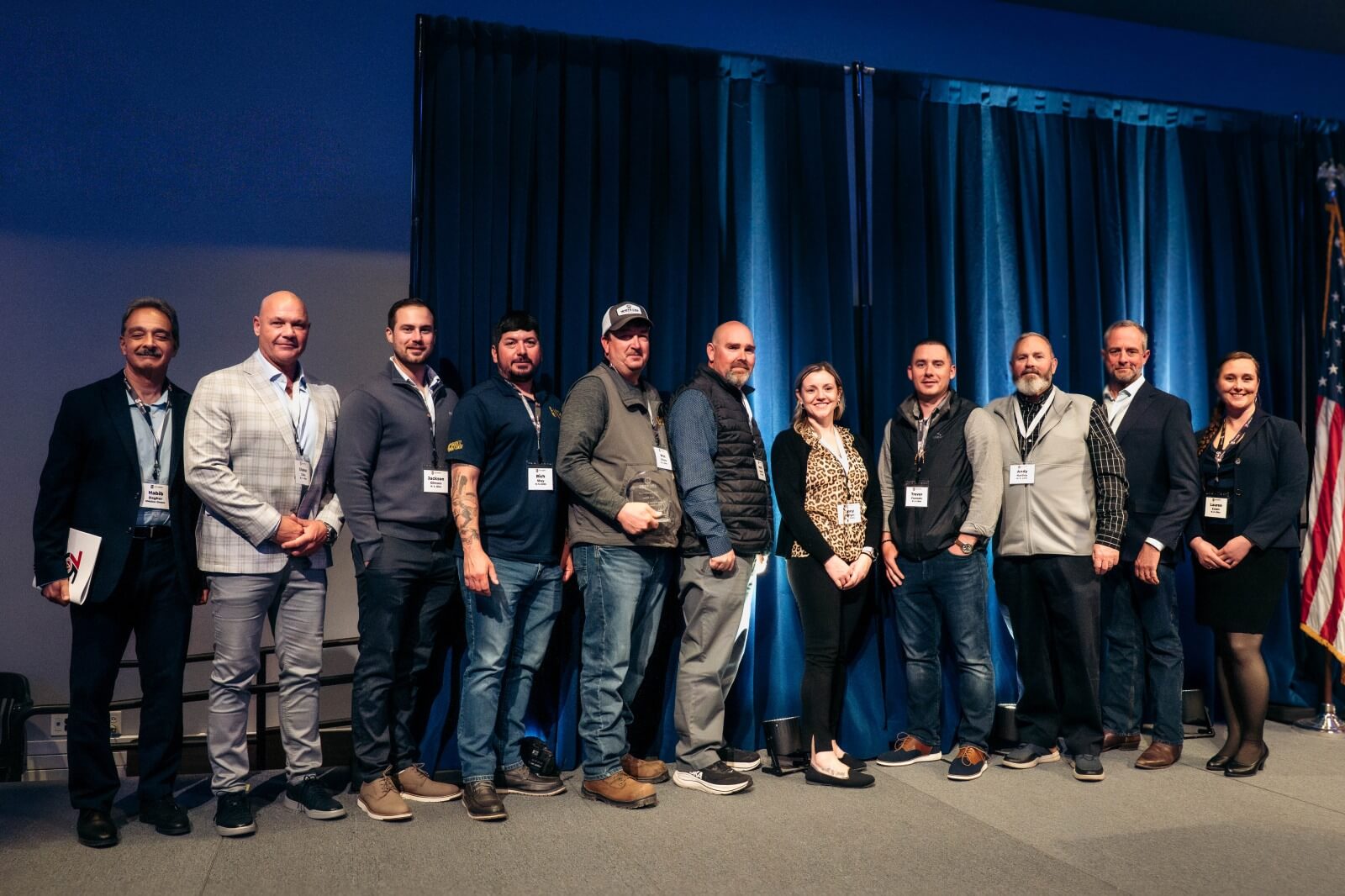
NS Giles Wins Specialty/Sub-Contractor Division Award for their Floating Concrete Platform Project
This project represents one of the most technically demanding and innovative concrete construction efforts ever executed in the State of Maine. Contracted by the University of Maine, the team successfully delivered a first-of-its-kind floating concrete research platform, constructed at the Trenton boat launch and launched into Frenchman Bay during a king tide before being transported offshore for final deployment.
Designed to support advanced offshore research, the structure serves as a scaled model for full-size marine platforms, positioning Maine at the forefront of floating concrete technology. Its successful execution required a highly specialized approach to materials, sequencing, and construction methods, all within a constrained coastal footprint and under challenging environmental conditions.
THE CHALLENGE
Delivering this structure required overcoming a series of challenges rarely encountered in traditional construction. As a scaled-down version of a full-size offshore platform, the project introduced unique constructability constraints, particularly within extremely thin wall sections containing centered reinforcement and post-tensioning systems.
Exterior walls measured just 5 inches thick, with interior walls as narrow as 4 inches and heights reaching up to 18 feet. With post-tensioning cables centered within these sections, crews had less than 1.5 inches of clearance on either side for concrete placement and consolidation, leaving virtually no margin for error.
Rather than relying on conventional methods, the team approached the work with a high level of technical discipline and risk management. Full-scale mockups were conducted in partnership with Owen J. Folsom, Inc. to refine the concrete mix, placement techniques, and lift sequencing. A controlled five-foot lift height was established to ensure consistent and repeatable results, eliminating uncertainty before production work began.
The challenges extended beyond geometry. The structure required strict control of shrinkage, permeability, and watertight performance for long-term marine durability. Construction also had to account for winter conditions, temporary shoring systems, SPMT access for launch operations, and integration around a central steel mast.
Each phase demanded careful planning and coordination between designers, suppliers, and field crews. From initial placements to the final launch on March 30, the project demonstrated a methodical, team-driven approach to solving complex problems under pressure—without compromising quality, safety, or schedule.
INNOVATION
Innovation was central to the project’s success, beginning with the development of a highly specialized concrete mix tailored to both structural and buoyancy requirements. In collaboration with the University of Maine, the Advanced Structures & Composites Center, and Owen J. Folsom, Inc., the team engineered a lightweight self-consolidating concrete (SCC) capable of flowing through extremely tight reinforcement zones while maintaining strength and durability.
The mix incorporated 3/8-inch lightweight aggregate to reduce density, along with crystalline waterproofing admixtures, shrinkage-reducing additives, and hydration stabilizers. These components enhanced permeability resistance, controlled cracking, and ensured consistent performance during slow, controlled placements.
To validate performance, multiple full-scale mockups were conducted prior to construction. These tests refined mix properties and placement strategies, ensuring the material could perform reliably within the project’s demanding geometry.
Construction techniques were equally innovative. The structure was elevated approximately four feet above grade on a custom-engineered shoring system to allow for launch access. Interior wall sections containing dense pipe penetrations required the development of custom stay-in-place foam formwork, as conventional forming systems were not feasible.
Laser-guided precision, lift-by-lift placement strategies, and proactive material procurement (during a supply shortage) further supported successful execution. Together, these innovations transformed a complex theoretical design into a buildable, high-performance structure.
ENVIRONMENTAL SENSITIVITY
Environmental responsibility was embedded in both the purpose and execution of the project. The project also contributes to long-term efforts to reduce greenhouse gas emissions and diversify energy infrastructure.
Sustainability considerations also guided construction decisions. The lightweight concrete mix was engineered for long-term durability in marine conditions, reducing maintenance needs and environmental risk over the structure’s lifecycle. Building the platform locally minimized transportation impacts while leveraging Maine-based expertise in marine construction.
These efforts demonstrate how advanced engineering and construction practices can align with broader environmental goals—connecting local craftsmanship to global sustainability initiatives.
SAFETY PERFORMANCE & INNOVATIOIN
Safety execution on this project required the same level of rigor as the engineering itself. Construction took place during Maine winter conditions, with sustained cold temperatures, high winds, elevated work surfaces, and confined placement zones.
The structure was built on engineered shoring approximately four feet above grade, followed by vertical wall placements up to 18 feet in height and a suspended slab-on-deck system. These conditions introduced complex risks, including fall exposure, narrow working areas, and challenging formwork configurations.
Recognizing that standard safety procedures were insufficient for this type of work, the team developed a site-specific Standard Operating Procedure (SOP) for elevated deck construction. This proactive approach addressed tie-off sequencing, anchor point selection, leading-edge protection, and rescue planning, and was integrated into daily job hazard analyses and crew training.
Additional measures included thermal protection planning, controlled access zones, engineered shoring inspections, and carefully sequenced lift operations. This disciplined, pre-planned approach ensured that safety was not reactive, but fully integrated into every phase of construction.
Over the course of the project, despite the compounded challenges, the team achieved zero recordable injuries—demonstrating that even highly complex and unconventional construction can be executed safely through preparation, accountability, and strong field leadership.
CONTRIBUTION TO THE COMMUNITY
This project represents a direct investment in Maine’s workforce, economy, and future as a leader in advanced construction. Fully funded through federal research initiatives, the project ensured that local engineers, tradespeople, suppliers, and students were actively engaged in a first-of-its-kind build.
By designing and constructing the platform locally, the University of Maine reinforced the state’s role as a hub for innovation in marine construction and material science. The project created opportunities for collaboration across academic institutions and industry partners, strengthening the region’s technical expertise.
Beyond construction, the platform serves as a long-term asset for education and research. It provides hands-on learning opportunities for students, supports applied engineering studies, and contributes to the development of future infrastructure solutions. The economic impact extended across local supply chains, from material providers to marine service companies, while the knowledge gained remains embedded within Maine’s workforce.
PARTNERING
The success of this project was driven by a strong and transparent partnership between the construction team, the University of Maine, and key collaborators. From the outset, the team embraced a solutions-oriented approach, working collaboratively to address complex technical challenges and evolving project needs.
Full-scale mockups, ongoing testing, and open communication ensured that all stakeholders remained aligned on performance expectations and constructability. This proactive coordination allowed the team to refine methods, mitigate risks, and maintain progress despite the project’s inherent complexities.
The partnership extended into execution, where design intent, material performance, and field conditions were continuously evaluated and adjusted in real time. This level of collaboration ensured that the final structure met rigorous research and durability standards while staying ahead of schedule.
CONCLUSION
This floating concrete research platform stands as a milestone achievement in Maine’s construction industry, demonstrating innovation, precision, and collaboration at an exceptional level. By successfully delivering a first-of-its-kind structure under demanding conditions, the project showcases the capabilities of Maine-based teams to execute nationally significant work.
Beyond its technical accomplishments, the project contributes to global advancements in renewable energy, supports local workforce development, and reinforces Maine’s leadership in marine construction and material innovation.
Delivered safely, ahead of schedule, and to an exceptional standard of quality, this project exemplifies the ingenuity, craftsmanship, and professionalism that define the Build Maine Awards.
Learn more about the Build Maine Awards at www.agcmaine.org/bmas