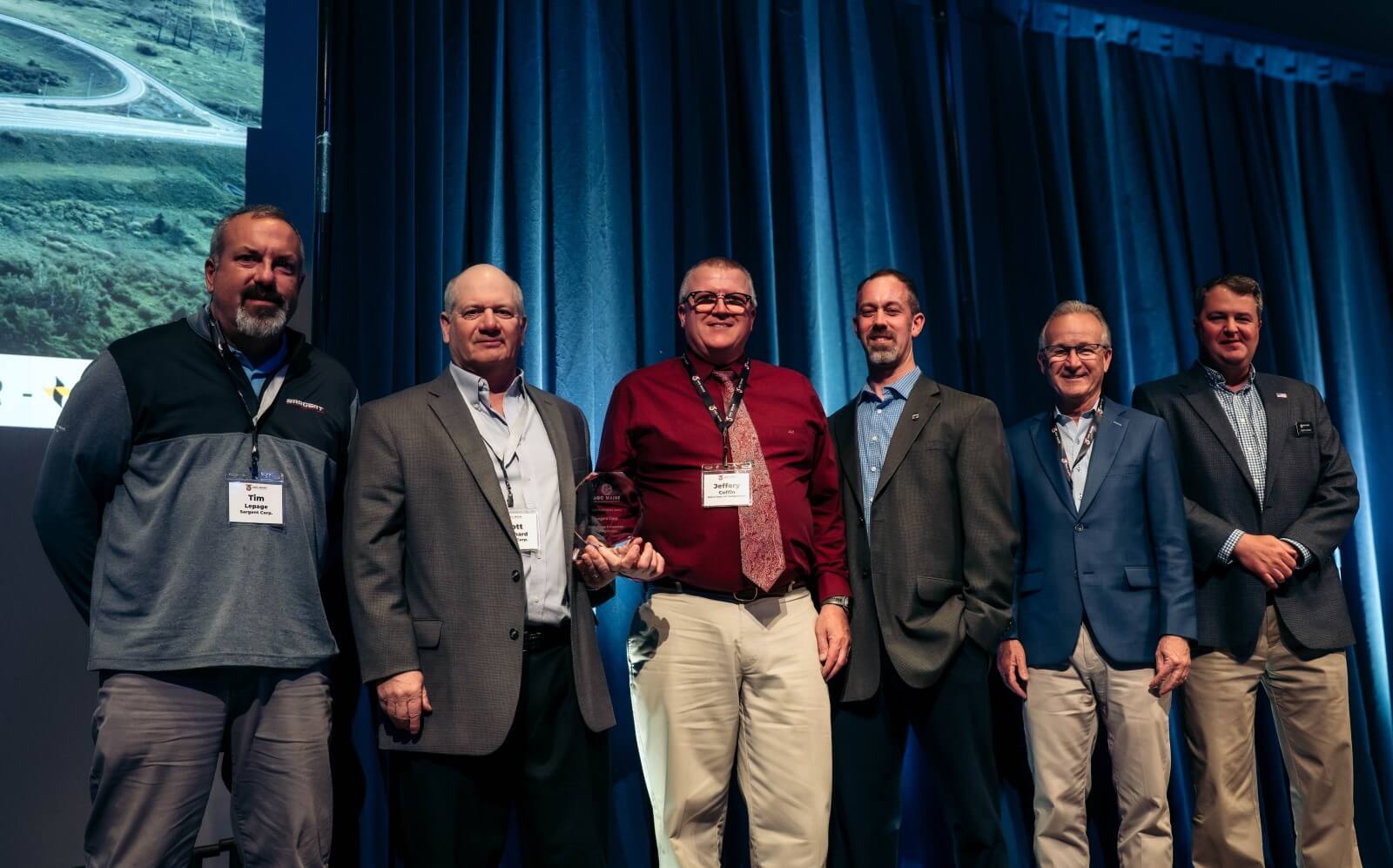
Sargent Corporation Wins Highway Award for the I-395/Route 9 Connector Project
For decades, trucks hauling freight between eastern Maine, the Canadian Maritimes, and the interstate had no good options. They rumbled through downtown Brewer and along Routes 46 and 1A—two-lane local roads that were never built for that kind of traffic. The I-395/Route 9 Connector finally fixes that.
The six-mile controlled-access highway connects the region the way planners had long envisioned, with 12-foot lanes, 8-foot shoulders, five bridges, and a modernized interchange with I-395. Designed for 55 mph travel, it pulls heavy trucks off neighborhood streets and onto a corridor built for them. Three and a half years after breaking ground, Sargent delivered it on time and on budget in June 2025.
CHALLENGE
The ground itself was the first obstacle. Much of the alignment ran through soft clay, organic peat, and wetlands; terrain that would swallow a conventional roadway embankment. The solution was a ground improvement campaign on a scale rarely attempted in Maine: more than 850,000 vertical feet of prefabricated wick drains, installed to pull water out of the soil and accelerate consolidation. Settlement plates and pore-pressure sensors tracked conditions in real time, so crews knew exactly when the ground was ready to take more load.
In the worst spots, that still wasn't enough. Workers placed between 66,000 and 77,000 cubic yards of foamed-glass aggregate—installed in lifts up to 20 feet thick—to reduce pressure on soils that couldn't handle traditional fill. Because the corridor ran largely away from existing roads, getting material to those areas was its own problem. The team had to build access routes from scratch while routing sustained hauling operations over municipal roads.
Maine's winters added pressure. A 90,000-cubic-yard sand drainage blanket had to go down across swampy ground, often in freezing temperatures, before spring weight restrictions shut down heavy hauling. Meanwhile, five bridges and seven large box culverts had to be sequenced carefully to keep local roads open throughout. At Felts Brook, unusually unstable soils required enhanced foundation work and continuous monitoring. And raising high-voltage transmission lines to allow safe bridge construction—without touching the roadway alignment—demanded its own careful coordination with Versant Power.
INNOVATION
The wick drain program, paired with real-time monitoring, pushed the boundaries of what geotechnical work typically looks like on a Maine highway project. Rather than guessing when soils were ready, the team had data—and used it to make decisions that protected both the schedule and the long-term integrity of the road.
Foamed-glass aggregate was a practical innovation with a bonus: it's made from recycled post-consumer glass. It solved a structural problem and supported sustainability goals at the same time. A dedicated quarry in Clifton supplied roughly 168,000 cubic yards of gravel, keeping material quality consistent and cutting down on long hauls. GPS-guided grading equipment improved precision across a site that, at its scale, left little room for rework.
Securing an early in-stream work waiver let crews complete critical work ahead of spring flows—reducing both schedule risk and ecological disruption.
ENVIRONMENTAL SENSITIVITY
The corridor cuts through wetlands and multiple stream systems in the Felts Brook and Eaton Brook watersheds, so protecting water quality wasn't optional—it was built into every phase of the work. Cofferdams, silt curtains, and temporary diversions kept construction away from active flows. In-stream work was scheduled within approved environmental windows. Once construction wrapped, streams were restored with natural materials, and disturbed ground was stabilized through revegetation, erosion-control matting, and riprap.
Permanent stormwater infrastructure—infiltration basins and trenches—manages runoff long after construction is done. Wildlife fencing guides animals toward designated crossings, and culverts were designed to maintain natural streambeds for fish passage. Clearing debris and asphalt millings were recycled where feasible, and blasting schedules were limited to reduce noise and vibration impacts on surrounding areas.
SAFETY
The risk profile on this project was real: heavy equipment, soft ground, bridge work over active roads, and in-stream construction all running concurrently. Daily briefings, job hazard analyses, and detailed pre-task planning kept crews aligned as conditions shifted and trades overlapped.
Most construction happened off the existing road network, which naturally limited exposure to the traveling public. When closures or detours were unavoidable, the team coordinated with local officials and emergency responders and communicated proactively with the community. In-stream work required controlled access and water safety protocols. Bridge construction included lift planning and fall protection systems. Working near high-voltage lines meant strict clearance protocols and careful sequencing.
Geotechnical monitoring played a safety role too—by confirming soil stability before adding load, the team avoided conditions that could have caused sudden settlement or equipment hazards.
COMMUNITY
The most immediate community benefit is straightforward: trucks are off the local roads. Downtown Brewer and the surrounding neighborhoods no longer carry freight traffic they were never designed to handle.
During construction, the project fed work to a large regional workforce and engaged numerous Maine-based subcontractors and suppliers. Sargent used the project as a platform for industry education, hosting University of Maine engineering students for annual site visits and opening tours to the Maine Better Transportation Association—giving both future engineers and industry peers a close look at what large-scale infrastructure work actually involves.
PARTNERING
Sargent's relationship with MaineDOT set the tone early. Participation in MaineDOT's constructability committee brought both teams to the table before a shovel hit the ground, surfacing risks and refining sequencing while there was still time to act on them. That collaboration carried through construction, with regular coordination meetings and close communication with Resident Engineer Jeff Coffin and Project Manager Steve Groves.
When the unexpected came up—accommodating oversized wind turbine components along a partially completed section of corridor, coordinating the transmission line raise with Versant Power—the team adapted without losing ground on schedule or budget. The project came in on time and on budget, which is the clearest measure of how well the partnership worked.
CONCLUSION
The I-395/Route 9 Connector exemplifies the qualities recognized by the Build Maine Awards: technical excellence, innovation, environmental stewardship, and meaningful community impact. By transforming a long-identified need into a modern, high-performing transportation corridor, the project strengthens regional connections while improving safety and quality of life.
Learn more about the Build Maine Awards at www.agcmaine.org/bmas