
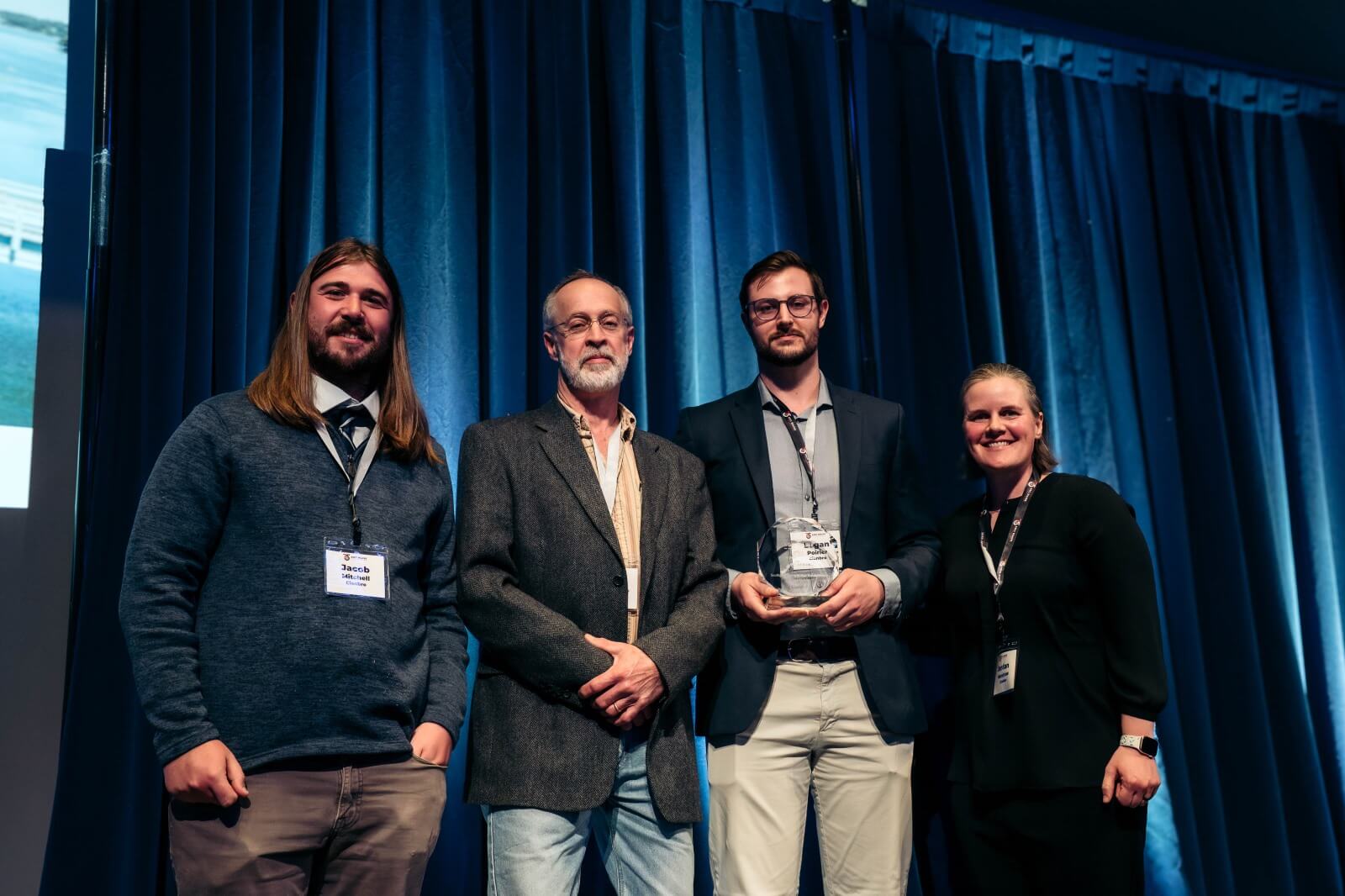
Cianbro Wins Bridge Division Award for the Rehabilitation of the Southport Swing Bridge Project
Sitting at the mouth of the Townsend Gut between Southport Island and Boothbay Harbor, the Southport Swing Bridge has been doing its job since 1939. It's one of the last operational swing bridges left in New England, carrying roughly 3,250 vehicles a day—a number that climbs each summer as tourists fill the coastal communities on both sides. Every half hour during peak months, the bridge swings open to let through tour boats, fishing vessels, and recreational boaters. For the residents and businesses of Southport Island, it's the only way in and out.
After more than eight decades, that kind of continuous use takes a toll. The bridge's structural, mechanical, and electrical systems had aged to the point where reliability was becoming a real concern. Periodic work over the years—mechanical upgrades, repainting—had kept things running, but a comprehensive rehabilitation could no longer be deferred.
Cianbro's scope covered structural strengthening, full replacement of the electrical and mechanical systems, new fender systems, a new control house, and replacement of the barrier gates and traffic control systems. Working on a historic movable bridge with this level of complexity required tight coordination among the contractor, client, and several engineering partners, including VHB, Total Control Systems, Wiss, Janney, Elstner Associates.
To manage that coordination, Cianbro assigned an in-house movable bridge coordinator—a dedicated role that proved its value quickly. More than forty change orders were processed over the course of construction, most of them triggered by conditions that only became visible once work was underway. Having someone in-house whose sole focus was scope management and stakeholder communication kept those changes from compounding into larger delays.
The most consequential discovery involved the bridge's reduction gears. They had been slated for rehabilitation, but closer inspection revealed they wouldn't hold up for the required service life. The original manufacturer confirmed it, and the decision was made to replace them entirely. With eight months left on the schedule and a six-month fabrication lead time, that left almost no margin. Cianbro and the client moved quickly, adjusted the timeline together, and kept the project on a clear path to completion.
INNOVATION
The site's tight footprint shaped nearly every major decision, including one of the project's most consequential design changes. The original foundation plan called for drilled shafts, but the equipment needed for that work would have required barge-based operations, adding cost and complexity the site didn't need. Switching to a micropile system solved the problem. Smaller, more maneuverable equipment could work within the constrained area without marine staging, and the foundation work moved forward without the disruption that barge operations would have caused.
The in-house movable bridge coordinator role was itself an innovation in project delivery. Rather than outsourcing that function, keeping it internal gave the team faster decision-making, tighter communication with design partners, and a clearer understanding of the bridge's day-to-day operational requirements. When conditions changed—and they changed often—the team could respond without waiting on outside coordination.
COMMUNITY IMPACT
For Southport Island residents, there is no alternate route. Keeping the bridge open throughout construction wasn't a preference; it was a requirement. The team installed a temporary steel barrier system that maintained one-way traffic flow even during the heaviest construction activity - throughout the summer months when local businesses depend most on access.
Marine traffic received the same consideration. The bridge continued its regular opening schedule, keeping tour boats, fishing vessels, and recreational boaters moving without forced detours or delays.
The team also found ways to give back directly. When a coastal storm damaged nearby waterfront infrastructure, salvaged materials from the original fender system were repurposed for repairs. Excess concrete from the project was donated for small-scale community fixes. And a working relationship with Thompson Cottages, a neighboring business, turned into something more than a standard lease arrangement—the team upgraded the borrowed space with new lighting, interior improvements, and a heat pump, and completed repairs to the property before leaving. The owners received better facilities out of the deal than they started with.
ENVIRONMENT
An osprey pair had built a nest on the bridge long before construction arrived, and under federal law, that nest couldn't simply be cleared away. Early in the project, the team used nonintrusive deterrents to discourage nesting and keep the schedule unaffected. Local residents pushed back, and after conversations with regulatory agencies, the team took a different approach: adjusting construction activities to work around the nest rather than remove it.
It worked. The osprey pair stayed, and during the first construction season, they hatched two chicks. It's a small detail in a large project, but it reflects something real about how the team balanced competing priorities.
CHALLENGES
Eleven feet. In some locations, that was the entire available work area. Large equipment was simply off the table, and everything—material handling, equipment selection, traffic control—had to be planned around that constraint.
For staging, the team partnered with E.M. Wood Construction, using their nearby yard as the primary laydown area. That arrangement required precise delivery coordination to keep materials flowing without backing up onsite. On the bridge itself, space was managed through creative stacking—including a double-decker trailer configuration that provided office space without expanding the project footprint.
Traffic control in those conditions required people who knew exactly what they were doing. Rather than rely on outside flaggers, Cianbro trained its own team, preparing them specifically for the frequent stoppages, tight maneuvering, and constant vehicle movement the site demanded.
SAFETY
Working in a narrow, active corridor over water creates a specific set of risks that standard safety plans don't fully address. The team established clear visual boundaries using barrels connected by safety chains, keeping work zones defined and personnel separated from traffic. Anyone working near the water's edge was subject to a 100% tie-off policy and mandatory life vest use. A water rescue plan was in place and ready.
A key component of the project’s safety success was the implementation of Cianbro’s CORE Committee. This collaborative group brought together team members from across the project to identify and address potential hazards. Weekly site-wide safety walks allowed for continuous evaluation of conditions, with findings documented and tracked through a central safety board. This proactive approach fostered a strong culture of accountability and ensured that safety remained a shared responsibility across the entire team.
CONCLUSION
The rehabilitation of the Southport Swing Bridge demonstrates Cianbro’s ability to deliver complex infrastructure improvements while maintaining uninterrupted service to the communities that depend on it. Through adaptive problem-solving, strong coordination, and a commitment to safety and environmental stewardship, the team successfully modernized a critical and historic asset without compromising its operation. The result is a more reliable, resilient bridge that will continue to serve Southport Island and the surrounding region for decades—making it a deserving recipient of the Infrastructure Award.
Learn more about the Build Maine Awards at www.agcmaine.org/bmas