
PC Construction Wins Building Renovation Award for UMaine Shawn Walsh Hockey Center & Alfond Arena
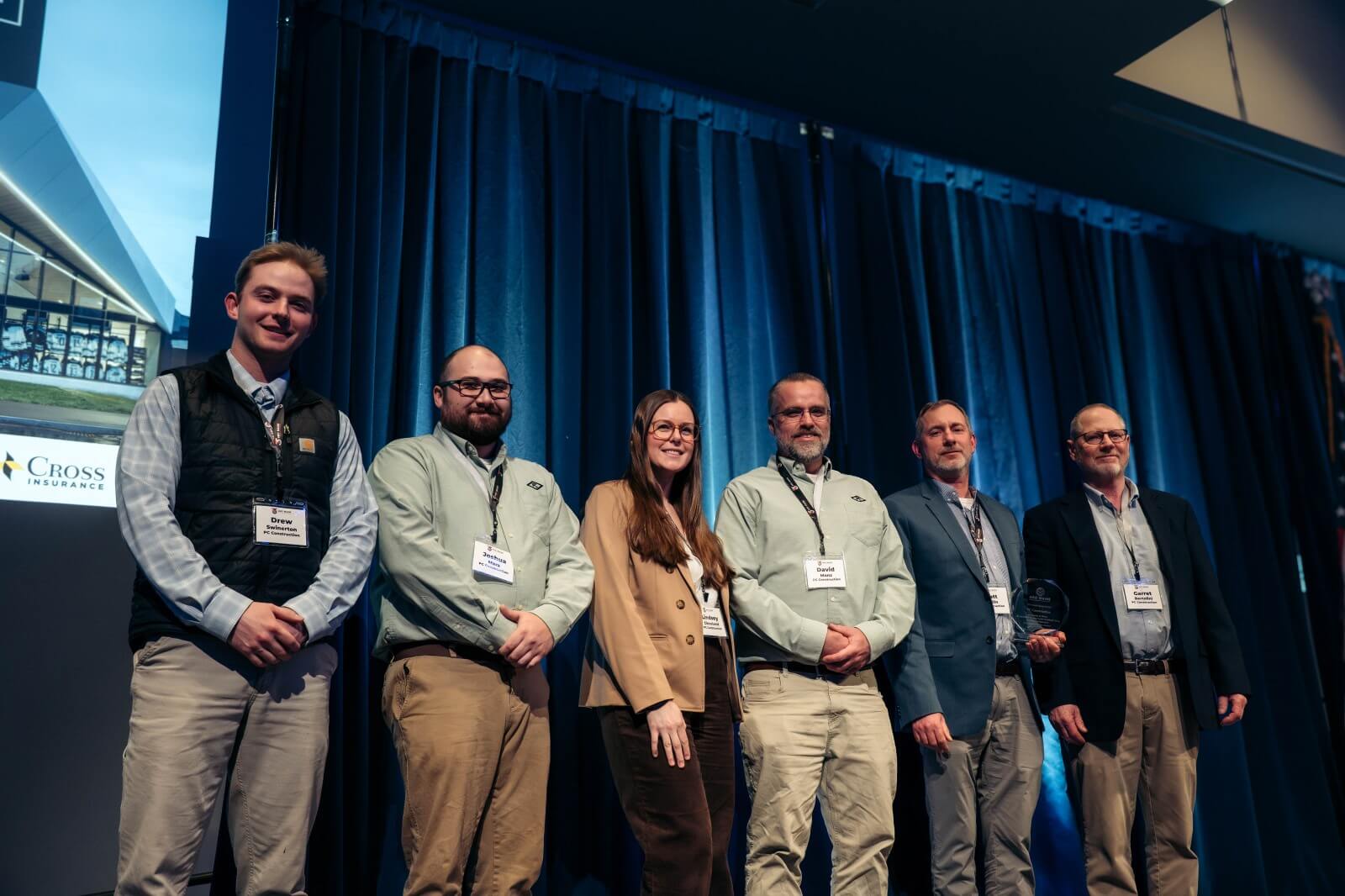
The University of Maine Shawn Walsh Hockey Center and Harold Alfond Sports Arena Renovation and Expansion represents a landmark investment in collegiate athletics, delivering the most significant transformation of Maine’s only NCAA Division I hockey venue in its 46-year history. This $40.1 million construction management-at-risk project modernizes a beloved and iconic facility while preserving its historic character and advancing the University’s commitment to gender equity, student-athlete development, and fan engagement.
At the heart of the project is the complete overhaul of the Shawn Walsh Hockey Center, introducing state-of-the-art locker rooms for both the men’s and women’s ice hockey programs, a dedicated player development center with strength, conditioning, and sports medicine spaces, expanded equipment areas, a 42-seat film room, and upgraded offices for coaches and support staff. These improvements position UMaine Athletics to better support elite performance while ensuring equitable, high-quality facilities.
The Harold Alfond Sports Arena underwent significant enhancements to elevate the overall fan and community experience. A new entryway and expanded concourse now house a dedicated fan shop, concessions, ticketing areas, and the UMaine Hockey Hall of Champions, creating a more welcoming and engaging environment.
Spanning 31,000 square feet of renovations and 21,000 square feet of new construction, the project was executed within an active campus and competitive Division I athletics environment. Delivered in time for the 2025–26 hockey season, the revitalized facility strengthens the University of Maine’s position as a premier hockey destination in the Northeast.
CHALLENGE
Executing a major renovation and expansion within an active Division I athletics facility presented significant logistical and technical challenges. Construction had to be carefully phased around hockey seasons, practices, campus events, and year-round ice operations, requiring close coordination to maintain safety and functionality throughout.
One of the most complex aspects involved integrating modern athletic and mechanical systems into a structure originally built in the 1970s. This required intricate structural tie-ins, system upgrades, and the installation of energy-efficient mechanical systems within an existing building envelope while preserving the arena’s iconic form.
Demolition demanded exceptional precision, particularly in areas adjacent to occupied and operational spaces. A notable example was the removal of an interconnected courtyard, where precast flooring also served as a roof over critical mechanical and electrical rooms that had to remain operational. The team used protective enclosures and crane-assisted removal to ensure uninterrupted operations.
The schedule was equally demanding. With construction beginning after the 2024–25 hockey season and substantial completion required before the 2025–26 season, the team implemented a six-day workweek and leveraged off-hours work. Lean construction practices, including Pull Planning, improved coordination and allowed the team to adapt quickly to evolving conditions.
INNOVATION
Innovation was key to delivering this complex project within an existing facility. A 3D scan of the building’s exterior envelope allowed the team to accurately assess existing conditions and ensure seamless integration of new systems. Infrared roof scanning identified areas requiring repair, while 360-degree pre-wall documentation provided valuable reference data for the University’s future maintenance.
Architecturally, the project introduced a distinctive “origami” metal wall panel design, composed of folded composite panels that create dynamic geometric forms. This system required precise fabrication and installation to maintain clean lines and consistent alignment across varying angles.
To support this level of precision, multiple in-place mockups were constructed, and laser scanning was used to refine fabrication. A continuous linear lighting system was integrated into the façade, working in tandem with a wood-look ceiling made from high-pressure laminate to create a cohesive and visually compelling exterior. The result is a modernized facility that respects and enhances the arena’s original architectural identity.
ENVIRONMENTAL SENSITIVITY
Sustainability was a guiding principle throughout the project. Natural daylight was introduced into above-ground spaces. High-efficiency glazing was used to reduce reliance on artificial lighting while improving occupant comfort.
New mechanical and electrical systems were designed for optimal performance, incorporating energy-efficient equipment, modern controls, and improved building envelope systems to reduce long-term operating costs.
Material reuse and waste reduction were also prioritized. The demolition process resulted in the recycling of metal, wood, and 21 tons of concrete, while existing asphalt was reclaimed and repurposed as subbase material for new pavement. These efforts reduced both landfill waste and the environmental impact associated with material transport.
SAFETY
Safety remained a top priority, particularly on an active campus with constant pedestrian traffic. Comprehensive protocols were implemented to protect workers, students, and visitors.
Site-specific planning included collaboration with university officials and local authorities to develop Interim Life Safety Plans, ensuring safe operations during hockey season, major events, and system shutdowns. Joint inspections during high-traffic periods helped maintain secure and accessible conditions.
After more than 30,000 work hours, the project achieved zero recordable incidents and a 0.0 incident rate—an exceptional accomplishment demonstrating the team’s commitment to safety.
COMMUNITY
The project made a meaningful impact beyond the construction site, serving as both an educational resource and a catalyst for community engagement. Recognizing the unique opportunity presented by building on a university campus, the team actively supported student learning through jobsite tours, technical sessions, and participation in Construction Industry Day.
Engineering and construction students were given direct exposure to real-world project challenges and solutions, helping to bridge the gap between academic learning and professional practice. The team also facilitated tours for donors, media, and stakeholders, keeping the broader community informed and engaged throughout the project.
PARTNERING
A highly collaborative approach between the construction team and the University of Maine was essential to the project’s success. Extensive preconstruction efforts established a clear understanding of budget, phasing, and constructability, enabling informed decision-making from the outset.
When grant funding became available to support ADA upgrades, the team worked closely with the University to identify eligible improvements and maximize the impact of the funding. This proactive approach ensured compliance while enhancing accessibility throughout the facility.
Mockups played a critical role in aligning the final product with the University’s vision. Full-scale installations, ranging from locker rooms to façade elements and graphics, allowed stakeholders to review and refine design details before final implementation, ensuring that functional and aesthetic goals were achieved.
Throughout construction, the team remained sensitive to the needs of students and campus operations, coordinating schedules to minimize disruptions and maintaining open lines of communication with university leadership.
CONCLUSION
The Shawn Walsh Hockey Center and Harold Alfond Sports Arena Renovation and Expansion exemplifies excellence in construction, collaboration, and community impact. By modernizing a historic facility while preserving its identity, the project enhances the experience for student-athletes, fans, and the broader university community—making it a deserving recipient of recognition through the Build Maine Awards.
Learn more about the Build Maine Awards at www.agcmaine.org/bmas